

A reduction in force gets planned as a payroll decision. Finance models severance, legal checks notice requirements, comms drafts the announcement. The health plan comes up later if it at all, usually as in the form of COBRA administration being handled.
It is handled, in the compliance sense. The notices go out, the deadlines get tracked, the vendor does its job. What doesn't get modeled is what happens to claims when thousands of people hit the same qualifying event in the same 30-day window.
And yet, for all the energy we put into making someone's first day great, almost no one has built a real solution for their last one. Departing employees, the people who helped build the place, are left to navigate one of the most stressful stretches of their working life on their own. This costs the company, too, in the form of COBRA premiums, if subsidized, and claims rendering COBRA employees 300% more expensive than an active employee. The fix isn't complicated, but timing is critical. The best time to set up a better off-boarding experience is before a transition is announced, not after.
Workforce change isn't slowing down
We're in an unprecedented time. Macro events such as revenue declines, cybersecurity incidents, employees aging into Medicare, and M&A dominate the news, and each one drives a workforce transition and a coverage dilemma for the people caught in it.
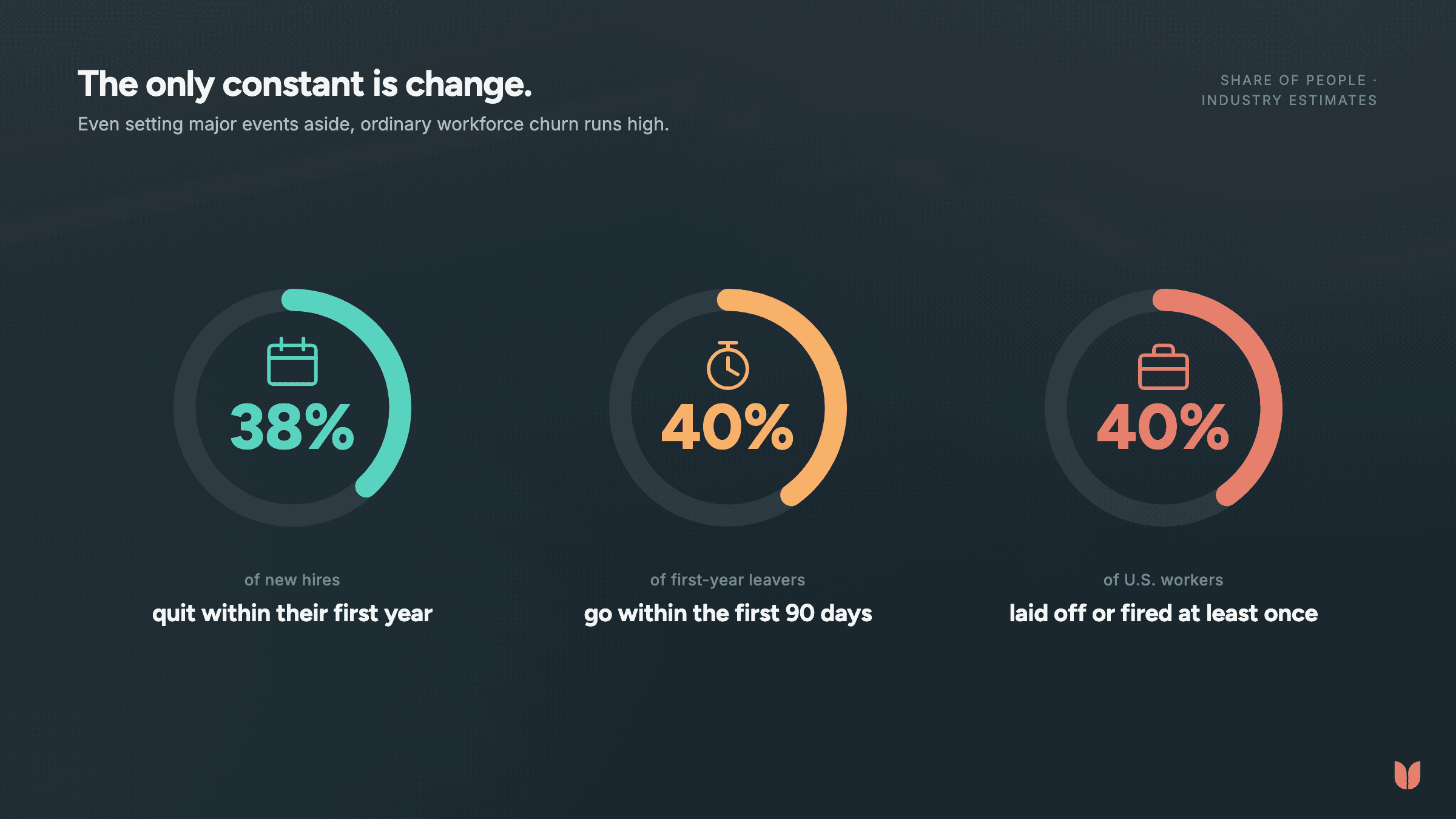
Even setting those events aside, ordinary workforce churn runs high. About 38% of people quit within their first year, and 40% of that group do so within the first 90 days. And by one estimate, roughly 40% of American workers have been laid off or terminated at least once in their career. The old adage holds: the only constant is change.
So, benefits and total rewards leaders, if you've already experienced some transition, you can count on more. If you haven't, you can count on it coming. Preparing costs little. It's negligible next to the cost of being caught unprepared. It's the same logic as any insurance policy: you don't buy one because you're hoping for a disaster. You buy it so you're covered if one comes.
What "too late" actually costs
COBRA election rates sit in the low double digits for most plans, and that number looks fine until you look at who's inside it.
The people who elect are the people who can't afford a gap. Someone mid-course on a specialty drug. Someone with surgery on the calendar for next month. Someone who found an oncologist they trust and doesn't want to start over with a new network. For them, paying 102% of the full premium is the rational call, because switching plans mid-treatment carries real risk.
Everyone else does the math and walks. A healthy 30-year-old sees an $800 monthly premium and lets it lapse.
That's adverse selection, and it runs on your plan all year at low volume. Federal data puts average annual spending for COBRA enrollees at $18,752 against $6,724 for active employees. They're 15.5 times more likely to file a $1M+ claim, which is where your specific deductible stops protecting you. A third of them are 55 or older, against 21% of your active population.
A RIF doesn't change any of that math. It just runs it hundreds if not thousands of times in a week.
Three things happen at once
Volume spikes. A year of qualifying events lands inside a single election window. The self-selection that normally plays out quietly across four quarters now resolves all at once, and it resolves the same way it always does.
The denominator shrinks. Those claims spread across a smaller active population. Per-employee cost climbs even if total spend holds flat. This is the part that surprises people at renewal, because nothing looks broken in the raw claims number.
The subsidy inverts. If severance includes COBRA support, the employer is paying to make the most expensive option the easiest one. It's a genuinely well-meant benefit and it works exactly as designed. It also removes the price signal that would have pushed some portion of that group to look at what else they qualify for.
There's a fourth thing that's less about economics. Someone who resigns for a new job usually has coverage waiting on the other side. Someone laid off in March has 60 days to make an insurance decision while rewriting a resume, filing for unemployment, and figuring out what to tell their family. Under that load, the option that requires no research wins. The default isn't chosen. It's absorbed.
Why the timing is worse than the volume
Stop-loss is where this shows up, and it shows up late.
A RIF in Q1 produces claims in Q2 and Q3 from members who are no longer on your census. Your carrier sees the experience at renewal. You see a quote. Nothing in a standard plan spend report separates COBRA claims from active claims, so the pattern reads as a rough year rather than the predictable consequence of a decision made twelve months earlier in a room where nobody was talking about the health plan.
By the time the number is legible, every election window that produced it has closed.
The window is 60 days and it's already open
The one point in this whole sequence where the outcome can still change is the election period. It opens when the qualifying event is confirmed and closes when the person elects or the deadline passes.
For a laid-off employee, that's 60 days when they have the least attention available. Which is exactly why the default holds.
Changing it means getting a real comparison in front of them early, in a form they can act on without becoming an expert in individual health insurance in the middle of a job search.
That's what When™ does inside that window. Our platform connects to your HRIS or eligibility file, the separation triggers outreach the same day, and the departing employee sees COBRA priced next to ACA, Medicare, and private plan options built around their actual doctors and prescriptions. Our licensed, non-commissioned agents pick up the phone for anyone who doesn't want to sort through it alone, and because they earn nothing on the plan someone picks, the recommendation isn't shaped by a commission.
COBRA notices still go out on schedule. Nothing changes in your compliance process, your plan design, or your COBRA administrator relationship. Some people should elect COBRA, and when they should, our agents tell them.
Nobody loses an option. Your plan just stops paying for it.
Why proactive beats reactive (and why it's lighter than you'd think)
Most companies don't implement a solution to address this for two reasons: they don't know one exists, and they can't see what it's costing them. Your true COBRA expense doesn't surface in the standard health-plan spend reports leaders prioritize from. It hides inside the data, so nothing flags it as a problem worth solving.
The good news: once it's on your radar, it's remarkably easy to solve for with When ™. We simply need two things you already have, your SBCs and your premium rates, and our implementation takes weeks, not months.
Once When ™ is in place, you're covered. Like any good policy, it sits quietly in the background until the day you actually need it; and on that day, departing employees get a guided, personalized path to affordable coverage instead of a form letter, while your HR team gets a clean hand-off instead of a fire drill.
Because When's agents don't work on commission, the guidance is built around what's actually best for each person: an ACA plan with potential subsidies, a spouse's plan, or, for those who qualify, Medicare.
The win is mutual. Employers lower cost and risk. Employees get a better experience at the exact moment they need one. That's the beauty of preparing early instead of in a panic.
Deciding before the announcement
The uncomfortable part of the timeline is that the useful decision comes before the RIF is announced, and by then the RIF is confidential. You don't go shopping for the fire extinguisher during the fire. The companies that handle transitions well are the ones that decided how they'd handle them before the decision was ever on the table.
Standing this up is a month-long project using documents you already have, your SBCs and your premium rates. Standing it up during a reduction means asking a benefits team already managing severance, notices, and a communications plan to also onboard a vendor in the same week they're telling people their jobs are gone.
Most companies will run a reduction eventually. The exposure exists either way. What's actually being decided in advance is whether the people leaving have seen their options before the clock runs out on them.
See how When handles a transition the right way, schedule a demo. Or run the numbers yourself with the COBRA Savings Calculator.


